As PPC practitioners, we’re no strangers to the arrival of new targeting expansion options – and the attendant hype. AI Max for Search is the latest addition to this expanding arsenal, and like many of you, I’ve been fielding questions about whether it’s worth trying.
A few weeks in – with a few of my own tests now completed – here’s my current view.
In short, I’m on the fence – with about 70% of me hovering over the skeptical side of it.
In long…
Tried and Prejudice
Like most of Google’s targeting expansions, I expected AI Max to follow a familiar pattern: more volume at decreasing quality… A genuine trade-off but one not often worth making.
In my first test account, that’s pretty much how it played out.
Account #1
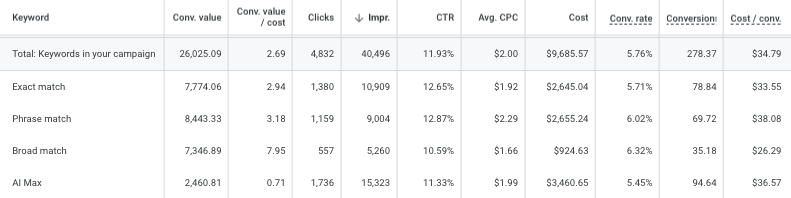
N.B. The search term match type segmentation is an excellent way to assess AI Max’s incremental value, and here’s what it shows about performance in that first account:
Highlights:
• Exact match: 5.71% CvR, $33.55 CPA, 2.94 ROAS
• Phrase match: 6.62% CvR, $38.08 CPA, 3.18 ROAS
• Broad match: 6.32% CvR, $26.29 CPA, 7.95 ROAS
• AI Max: 5.45% CvR, $36.57 CPA, 0.71 ROAS
Now, this could be worse. It delivered some value, and at conversion rates and CPAs lower than – but within touching distance of – the average.
The really damning metric was the most important – ROAS (conversion value/cost) at a loss-making 0.71. From this, AI Max showed a concerning pattern of finding and maxing out on lower-quality conversions (in this case, leads that didn’t progress beyond the initial inquiry (or ‘inquiry’)).
Despite having target ROAS to guide it – AI Max failed to find high-quality conversions within its incremental reach.
Account #2
But then my expectations hit a surprising data point.
I tested AI Max in a second account, that had been struggling for volume and conversions with traditional, targeted search.
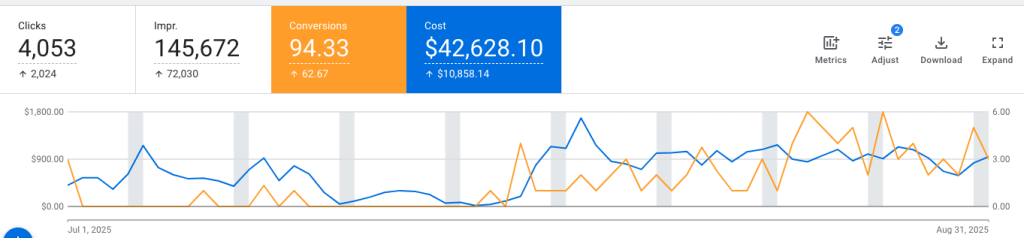
This account serves a high-end private medical service – specialist, niche, and high-ticket (often no-go territory for Google’s more expansive targeting options). No need to mark it on the chart, you can see the clear uptick at the point when AI Max was introduced – with cost jumping significantly, but conversions jumping by even more…
What was the difference? This account had limited search volume to begin with – and a greater reliance on exact match.
Despite long efforts to pick out the relevant search terms and give them sufficient breathing room, traditional search was struggling to generate sufficient traffic in this highly specialised niche, to convert well enough.
AI Max’s broader reach surprisingly boosted traffic with enough relevance to pick up decent conversions and give the algorithm momentum to produce the upward spiral we never quite meant to enter before.
Could the same results have been achieved by leaning hard into broad match? It seems likely – though we had given broad a crack at it, without much joy.
Red Flags from PPC Pros
Two specific concerns about AI Max’s targeting behaviour are emerging widely across the PPC community.
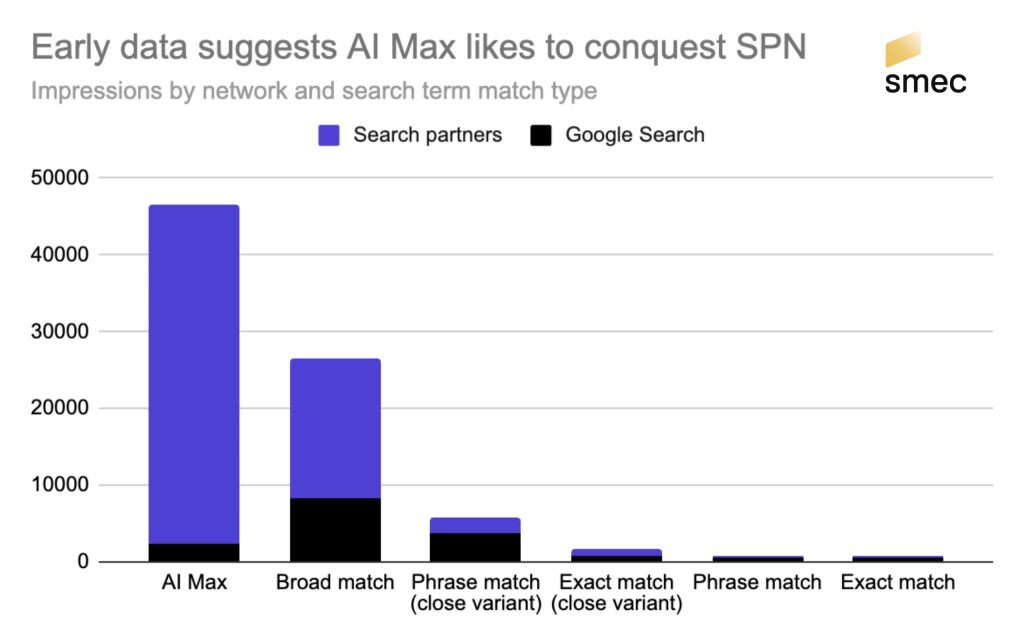
First, a heavy reliance on search partners traffic. Mike Ryan has taken a deep look into this and – with caveats about the data set – raised compelling concerns about this pattern, illuminated by his chart here.
Second, many advertisers are reporting that AI Max aggressively targets competitor terms – to the extent that Thomas Eccel has dubbed it ‘competitor Max’. Competitor targeting may not be all bad, especially with low CPCs, but (aside from the political risks of competitor bidding) competitor terms aren’t high on the list of high-quality traffic – so a pattern of bottom-of-the-barrel targeting does seem to be emerging.
Two more PPC heavy-hitters have recently raised specific notes of caution of what AI Max gets up to…
• Amy Hebdon highlighted the dangerous ability of AI Max to create its own ad text, which will then run without your prior approval.
NB Very soon afterwards (yesterday, as I write) – Google announced ‘text exclusions’ – to roll out over the next few months – allowing us to specify up to 25 particular words not to appear in auto-generated ads… So, some welcome mitigation for this issue.
• Brad Geddes (in a pincer movement) warned about the dangers of AI Max selecting its own landing pages, and how this can lead to traffic being sent to valueless or outdated pages, potentially harming both user experience and conversion rates.
So what to do with AI Max now?
We have…
• Mixed reviews – at best – of the quality of its output. (It’s a truly mixed picture from my own first-hand experience – and while I expect that the success seen in test #2 is probably a rare case. I can’t discount it as a data point)
• Several specific dangers stemming from the way AI Max is designed to work
With that in mind, these are the situations in which I would recommend testing AI Max:
✅ Limited search volume accounts struggling with traditional targeting despite good fundamentals
✅ Accounts in which you have either a great degree of freedom to experiment – or a very strong incentive to do so (i.e. you need a last resort option)
And here’s when I’d avoid it:
❌ Campaigns already seeing joy from broad match (much of AI Max’s best performance likely comes under the broad match band, with its incremental keyword-less targeting beyond broad match, less likely to provide incremental value)
❌ Accounts with high potential to send the algorithm off course with low-quality conversions (e.g. lead gen with a simple inquiry conversion… the same problem that plagues Performance Max for lead gen)
❌ Any case where ad copy is at all sensitive or needs pre-approval
👀 Like a hawk
If you do test AI Max, close monitoring becomes even more important than it usually is, and we have some good pointers on the danger areas to look out for.
• Search term reports (watch for competitor term volume and performance)
• Ad text variations being generated
• Landing pages used
• Search partner volume and performance
Anthony Higman recently called AI Max out as simply being “Just [Broad Match Keywords + DSA] In A Shiny New Ai Wrapper!“.
That’s pretty accurate – and we know what Broad and DSA bring to the table – so it clarifies the idea that turning a search campaign over to AI Max should really be considered either a YOLO move, or a Hail Mary pass.
It’s a non-precision tool in the kit for when you’re very free to experiment, or as a last resort.
Otherwise, no rush. Google is already rolling out additional controls, and meanwhile the PPC community continues to share valuable learnings that we can all use to make more informed decisions.