It sometimes occurs to me that if I was put on the spot and asked why I’d made certain decisions about moving a ROAS/CPA target up or down, I might find it hard to reconstruct the answer.
There are always multiple factors weighing on where to pitch a target. In practice – those background and foreground considerations can get mixed up into a single sense of which way and how far to move the dial.
So here is an attempt to set out all the specific factors that go into what is often – in practice quite – an instinctive action.
(Discussing ‘ROAS or CPA targets’ is always confusing because ‘up’ and ‘down’ have reverse implications between the two. So, for the purpose of this piece, we will stick to talking about ROAS targets.)
The first and most crucial point – that isn’t always obvious – is that targets should not be simply set to the desired ROAS level and left there.
It would be great if targets could play that role unassisted, but they can’t.
In practice, a target applies a certain degree of pressure to move the ROAS of its given campaign in the direction of the target.
Importantly, that pressure is stronger, the greater the gap between current actual ROAS, and the target ROAS (we’ll come back to that…)
But a target is not a strict directive to achieve that ROAS at all costs (there’s no way that could work in practice)… so within indistinct but quite wide limits, a campaign will run indefinitely at a ROAS higher or lower than your target.
And as
a) multiple internal and external factors also swing actual ROAS around – and
b) the priority your account places on volume vs profitability changes,
the direction and weight of that ‘target pressure’ is something we will want to shift fluidly as our campaigns run.
So there is no single, good answer to the question – ‘what ROAS target should we set for this campaign?’ This is like asking what direction to hold the steering wheel if you want to drive to Glasgow… The answer changes frequently as the journey progresses, influenced by the following factors.
1. Account-level priorities come first
What’s the status of the account as a whole? Do we want to increase spend or decrease it? Do we need to increase ROAS or is it currently more than healthy enough?
These questions will be relevant background to all individual campaign-level decisions.
2. Campaign role
for each campaign we’re assessing, what ROAS do you want or need to achieve?
This question deserves its own piece – but to avoid the rabbit hole we’ll just note to consider whether the campaign should be playing a higher-ROAS role (lower funnel, less incremental) or a lower-ROAS role than the account average. e.g. generic / vs brand.
3. Performance versus ideal
How is performance vs that ‘ideal target’?
If it’s strong, we generally want more of the same – and may be willing to sacrifice a little marginal ROAS to get it.
If it’s underperforming, we’ll either want to increase its ROAS or – if/while that’s not possible – reduce spend to mollify the impact of its underperformance.
4. Performance versus the current target
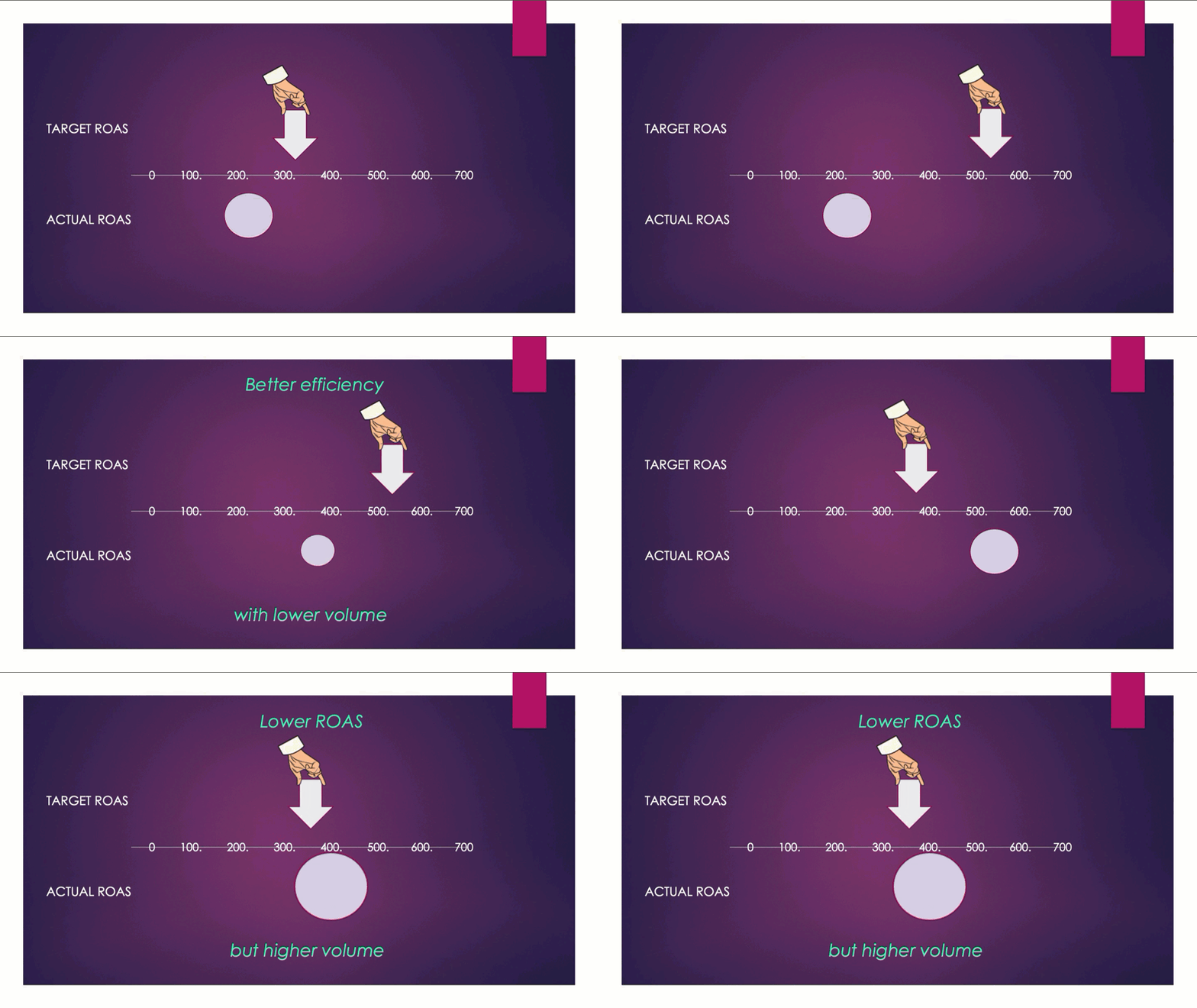
The extent to which this movement works in practice (on average – your mileage may vary…) is set out in this brilliant study by Smarter Ecommerce – one of those that’s worth bookmarking…
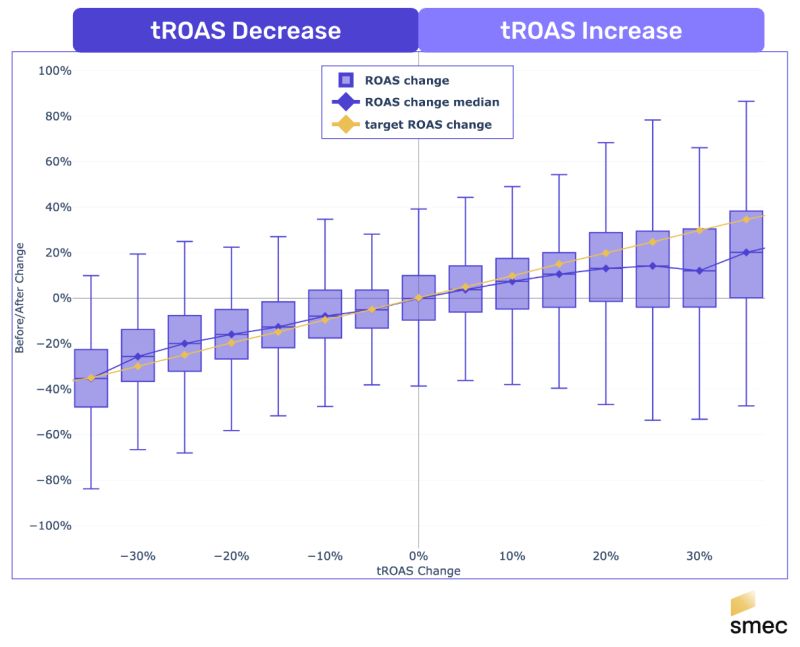
It shows the range and median change in ROAS following each given percentage of increase or decrease in the ROAS target.
By my reading, this shows that target changes work very reliably, provided we understand their mechanism is one of pulling ROAS towards them, not definitively or quickly moving that ROAS ‘all the way to them’.
5. Time since the last change
How recently has the target been moved?
i.e. to what extent is the current relationship between actual ROAS and target ROAS a reflection of the current target vs the previous targets?
We’ll need to give a new target some time to take effect before we can judge it on its own merits.
6. Potential impact and capacity
Lowering a ROAS target to open the door for more traffic is only a useful move if there is more of that traffic to be had.
Check your impression share loss metrics:
If there is impression share loss to rank, then there is something to be gained by lowering the target ROAS to tap into that impression share. You’re not bidding aggressively enough to capture all available impressions; a lower ROAS target gives the algorithm permission to compete more strongly in the auction.
If there is impression share loss to budget and you want more of the same, then there is no advantage in lowering your ROAS target – you will simply spend the same budget less efficiently. Instead, increase budget.
Conversely if we have a campaign that’s underperforming its target but its spend is very low, then there’s little to gain from further increasing its ROAS target.
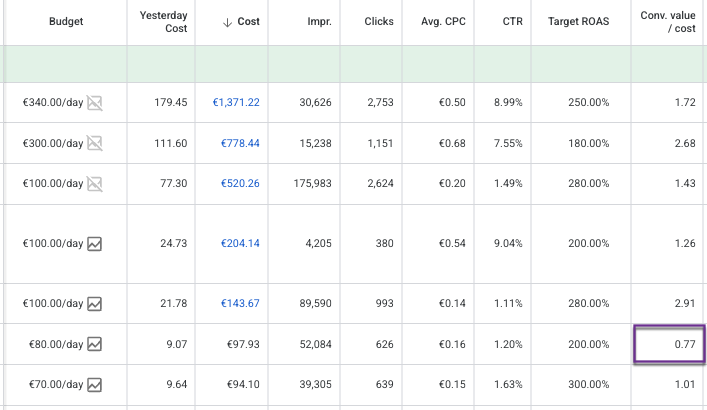
For the campaign with the low (highlighted) ROAS in this screenshot, in terms of pure performance, we might want to hike its target up.
But if we look at its current spend, it’s already limiting itself (yesterday it spent €9). So there’s not a lot of benefit in restricting it further. Let it run; it might come good. Meanwhile, it’s doing virtually no harm.
(We could even run counter to our usual decision process and decrease its target to give it more headroom to start proving itself, but either way it’s a low-stakes decision at this point. Its low-spend, low-ROAS contribution is having minimal overall impact.)
When you have nothing to trade…
A common and difficult situation is what to do when you’re struggling on both sides of the scales. i.e. you’re not spending much as you want to spend but you’re also not achieving the results you want to achieve.
While it’s a bit of a catch-22 – ROAS usually comes first in these situations. So, as long as you can identify any fat, keep trimming it… But when this situation drags on, at a certain point, we need a deeper solution.
Sometimes that means hitting reset, stripping right back to historically successful search terms, running them on exact match, and then trying slowly to expand from an ultra-tight core of profitable traffic. More on that reset method here.
Direction, not outcome
Target-setting is a dynamic process, not a one-time decision.
We’re constantly reading the signals – account-level priorities, campaign-level performance, the gap between where things are and where we want them to be, how recently we’ve made changes, and whether there’s actually capacity for a campaign to respond in the direction we’re pushing it.
In practice, these considerations naturally blend together, but isolating them – as we’ve done here – makes it easier to sense-check our decisions, spot when we might be missing something, and explain our rationale when we need to.
There’s no formula that spits out the right target for every situation. The skill is in weighing these factors against each other – and staying alert when the balance shifts.