The controls that we as PPCers have over bidding have certainly changed over the years.
While we used to adjust bids at the keyword level, the most granular option we now have is ad group-level target adjustments.
These are neither as direct (targets rather than max bids) nor as fine-grained (ad group rather than keyword-level), but they are the most detailed control we have to differentiate bidding levels – outside of Manual CPC.
So when some buzz started circulating a few months ago around that idea that ‘ad group targets are ‘fake’, it was worth investigating.
It was sparked by Google’s explanation on one of their support pages, of how ad group-level CPA/ROAS targets relate to the top-level targets set at the campaign or portfolio level.
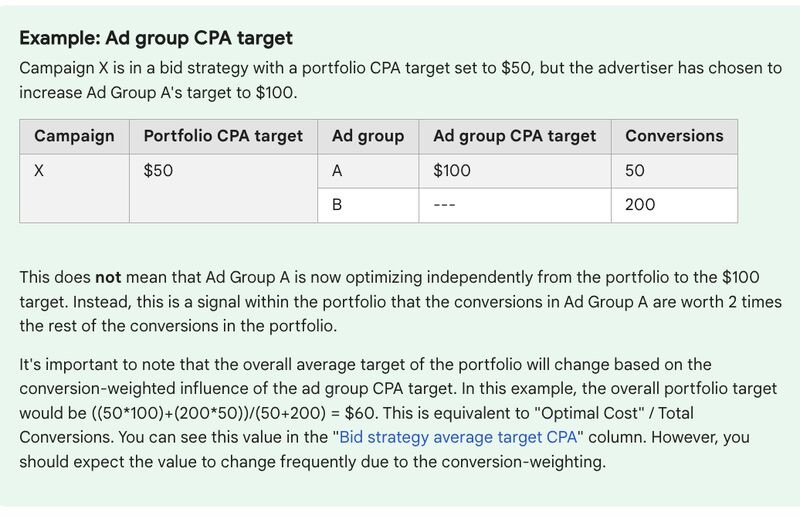
NOTE – this is from a support page for SA360.
While I, like most of those commenting on the issue, assume that the same mechanism is at work in vanilla Google Ads, that is not certain… (And doubt about the applicability of SA360 support info is a wider issue that needs to be addressed more generally.)
In any case, the ‘fake targets’ conclusion was an overreaction.
Ad group level targets clearly work to differentiate bidding aggression, ad group by ad group. Even according to the information quoted above, they’re not fake, they’re simply ‘anchored’.
But I believe that the controversy stemmed from a misunderstanding of what that anchoring towards an ‘average target’ means – and how it works… And my suspicion is that info on the support page itself resulted from the same misunderstanding.
What kind of ‘anchoring’ is at work?
As the (vanilla) Google Ads support page explains, there are ‘average target’ metrics – ‘avg. target CPA’ and ‘avg. ROAS’ – which take account of adjustments to the top-level target – from ad group targets and any other operating adjustments – to show the aggregated average.
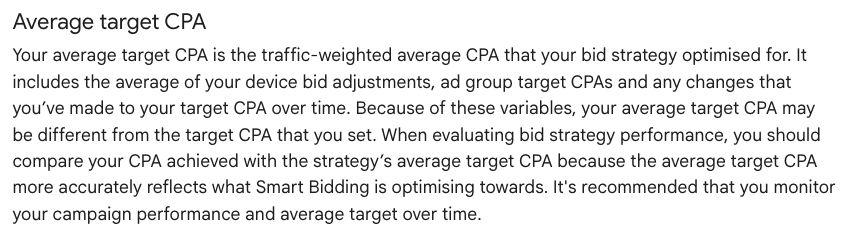
In summary – the average target towards which a campaign is aiming can be diverted from the top (campaign or portfolio)-level target, by the effect of different ad group level targets. We might note that this is already confirmation that those targets are not ‘fake’.
On the offending SA360 help page which sparked the ad-group target skepticism, the concept of the ‘average target’ was explained in more precise terms. It details exactly how each ad group-level target affects the ‘average target’ of the overall bid strategy – with some having more influence than others.
A target increase on a virtually inactive ad group should not – and does not – affect the ‘average target’ to the same extent as the equivalent target increase on a relatively high-traffic, high-conversion ad group.
Instead “the overall average target of the portfolio will change based on the conversion-weighted influence of the ad group CPA target.”
i.e. the effect of an ad group target on the overall average, is proportional to the % of total conversions that come from that ad group.
However, this confusing and – I believe misleading – line accompanied that explanation:
Where the portfolio target is $50, and ad group A is given a target of $100, “This does not mean that Ad Group A is now optimizing independently from the portfolio to the $100 target. Instead, this is a signal within the portfolio that the conversions in Ad Group A are worth 2 times the rest of the conversions in the portfolio.”
According to this explanation, raising the ad group’s target from the default $50 to $100 signals that its conversions are worth twice as much as those in the default set.
This is a reasonable interpretation.
But here’s where I think the help page went wrong:
If the bid strategy takes that signal seriously… If it starts working on the basis that conversions from that ad group are 2x as valuable as those in the rest of the portfolio, then it will, differentially, value clicks under that ad group x2 compared to others, where the target is $50.
That is all that’s required to say that it is independently optimising that ad group to a $100 target.
The portfolio as a whole is bound by its ‘average target’. The ad group isn’t.
My suspicion is that the author of this SA360 help article mistook the descriptive metric, ‘average target’ for an active algorithmic input, and on that basis, their explanation effectively flipped the cause and the symptom.
According to their description, ‘average target’ is what the algorithm is really working towards – and within that process, some ad groups weigh more than others…
But if my take is correct, then the set of ad group targets (if any) individually work to their own agenda, while ‘average target’ is merely the descriptive metric on the other side of their aggregation.
The overall effect is similar… but the help article’s wording, and its line about ad groups ‘not independently optimising’ to their individual target, is what sparked the round of ‘ad group targets are fake’ claims.
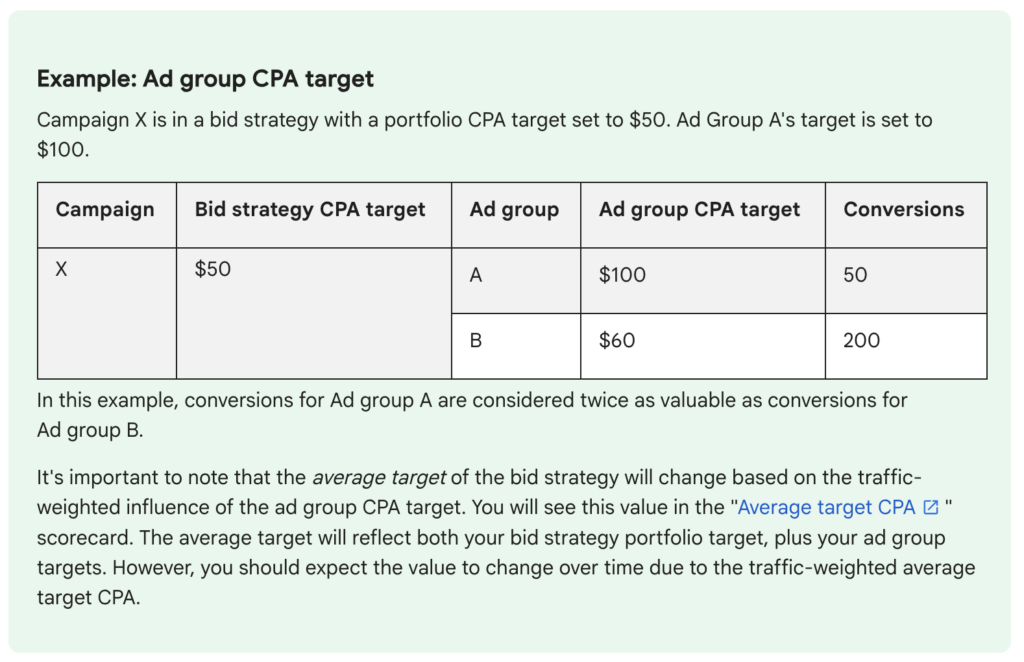
The final piece of evidence that the controversy stemmed from unclear documentation (not ineffective ad group targets) comes from the latest iteration of the same help page, in which that offending line about ad group targets not being independent, has been removed. See below:
It was an unfortunate misdirection, because ad group level targets are such an important lever when it comes to ‘correcting the algorithm’ (which yes, still needs to be done sometimes).
The bottom line: Ad group targets work exactly as intended. They’re not fake, or cosmetic, or even constrained in any meaningful way by their parental targets.
When you set an ad group target, you’re directly influencing how aggressively the algorithm bids for traffic in that segment. Use them confidently when you need to address or exploit performance differences, and the algorithm isn’t doing so adequately of its own accord.
For detail about why I think they’re so important (and what happened when I raised this with Google’s Smart Bidding product managers), see this blog post.