I recently faced a strange decline in one of my accounts.
Impression share tanked on a certain day, and remained low. On the same day, the ‘auctions insights impression share’ of all competitors plummeted along with it (we’re the red line).
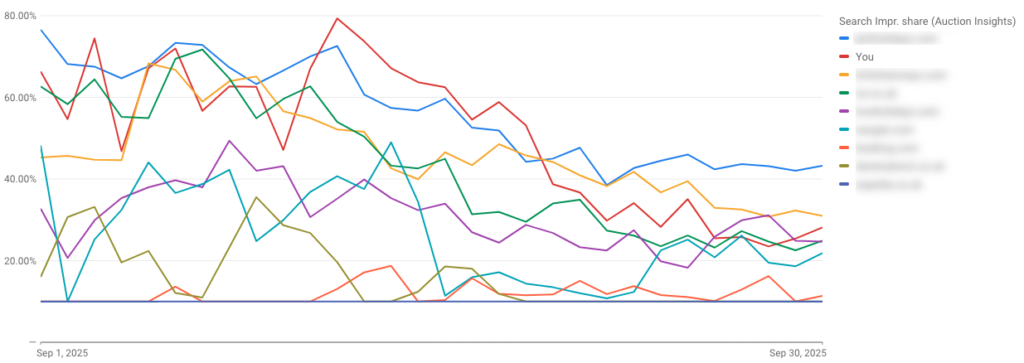
The cause was a mystery… but the fact that all of the competitors had lost so much ground together was a valuable clue. It seemed like the overall inventory of eligible impressions must have increased – and all competitors failed to keep up with it.
What could have caused a sudden increase in that total inventory?
There was something… Around that date we enabled AI Max in the relevant campaign. Increasing the pool of eligible auctions is precisely what AI Max could do!
A week or so later, we decided to disable AI Max (as has been the case after the vast majority of our AI Max tests at this point) and noted that if impression share returned to normal when we turned it off, that would be case closed on the ‘IS drop inquiry’….
The results could not have been clearer.
See in this auction insights report how both our own and our competitors’ impression share sprang back up to normal levels when turning AI Max back off on the 14th of October (we’re the yellow line).
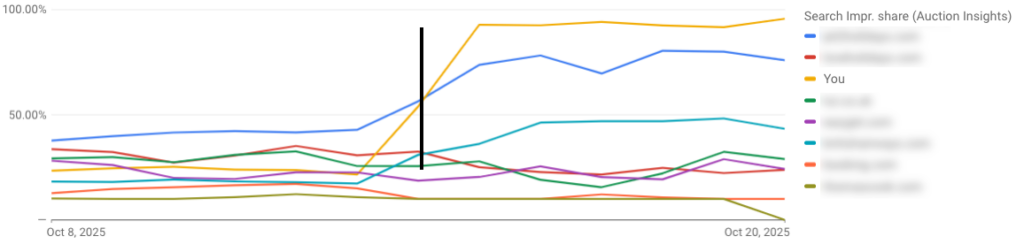
This is a stark reminder of a key point: Impression share has never been a great indicator of reach, because it depends as much on your total and eligible impressions (the whole pie) as it does on the share of those that you’re hitting (your slice of it).
That whole pie is not a fixed entity; the set of ‘total eligible impressions’ is heavily susceptible to (for example) changes in match type, adding new keywords, changing geographical targeting, excluding a device type or, as seen here, enabling an expansionary feature like AI Max.
Any of these can have a dramatic effect on that total set of eligible impressions. In this case, applying AI Max produced a huge jump in impressions but an even more dramatic dip in impression share.


There are plenty of other examples of this ‘denominator problem’ in Google Ads – and it’s easy to be caught out by it…
It’s one of the reasons why CTR isn’t a decent KPI. By expanding match types or enabling search partners you are likely to gain clicks but lose CTR. (The other, crucial reason is that higher CTR often correlates with lower conversion rates (see this video for why.)
Likewise (and more familiarly) lower ROAS often goes with higher revenue. High ROAS is easy when spend is minimal… But it’s not particularly useful.
So the same action can easily lower CTR while increasing clicks, or lower CVR while increasing conversions, or – as in the example above – increase impressions while reducing Impression share.
There are more examples of this metric relationship in Auction Insights report too.
A high ‘position above rate’ (% of times a competitors ad showed above yours in shared auctions) is only significant if the overlap rate (the % of your auctions that are shared with that competitor) is high. Otherwise, again, the denominator undercuts the significance of the proportion.
This warning applies to any performance metric that has ‘divided by’ in its formula…
It may look like it measures performance – but more accurately, it measures [performance ÷ opportunity], and opportunity is the ghost in the machine.