With fewer knobs and levers left for PPCers to adjust these days, the ones we do have carry greater weight. One that’s rarely discussed, and not always fully appreciated, is budget. It’s primarily considered as a dial on how much to spend, of course, but it’s a dial of performance optimisation as well as one of accountancy.
To be clear, throughout this piece, when I refer to budgets I’ll be referencing campaign daily budget – what used to be called the daily cap, and no longer is one. The rule, in short, is that we won’t be charged more than twice that daily budget on a given day, or 30.4 times it in a calendar month. So it’s a pacing target rather than a day-to-day ceiling.
We’re used to targets, ROAS or CPA, as the primary lever of efficiency, where a looser target allows activity to drift out from the most valuable central core towards less and less valuable inventory. In any conversion- or conversion-value-oriented bid strategy, the same can be true of budget.
Those strategies all work to some extent on a best-first basis: lowest-hanging fruit first, then climbing that tree branch by branch to reach ever more sparsely arranged prizes. How far and how high we can climb is determined by the budget, with returns diminishing as we spend more.
Targets don’t shield us from this entirely. The target sets the bar each impression has to clear in terms of predicted value. But it judges each one on its own merits, and it asks the same question again and again as long as there’s budget left to answer it with. The target per se doesn’t reliably stop us continuing to ask that question as we get further down the list of auctions. That’s the job of the budget.
Give PMax an inch
B2B lead gen, high-value product, PMax campaign (yep – danger zone, hard hats at the ready).
The story starts with a budget increase in pursuit of volume, from $1,000 a day to $2,000 a day. Performance dipped.
Why?
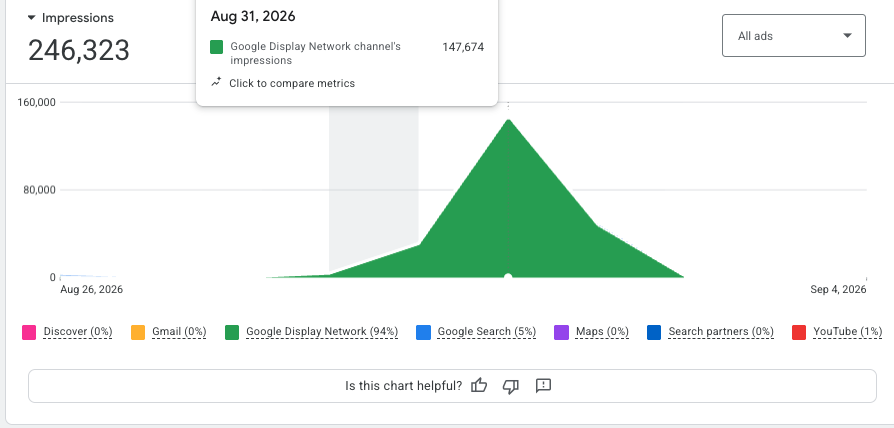
While the campaign was perfectly capable of spending that $2,000, it wasn’t capable of spending it well. The search element couldn’t absorb it. On the day display spend peaked, Google Search took around $1,700 of a day’s total of roughly $2,600 – overdelivery doing its thing – and display took the rest.
For its 9% of spend across the period, display produced 94% of the impressions and none of the conversion value. But it was damn cheap! Which is why it clears the bar so easily. Google doesn’t have to expect much of it to let it through the gate.
Note that this was with the target on its tighter setting. tROAS had gone from 50% to 70% shortly before the budget increase. We raised the bar, but allowed PMax to recruit a whole load more high jumpers.
More gold in those hills
You can be limited by budget without being limited by budget on ‘the good stuff’. It’s only the second of these that means there’s more gold in those hills. With Search campaigns, ‘limited by budget’ is relatively informative, because queries are finite: if the campaign can spend more, then roughly speaking there’s more available of what you want. With PMax, the inventory beyond search is effectively bottomless, so a campaign with any headroom in its target at all can always spend more. (‘Limited by budget’ is a highly positive state in that situation.) (In fairness, a second target hike may have solved the problem. But you can see how a target’s ability to hold a campaign in check weakens as the budget pushes a sudden rush of inventory at it.)More than one way to skin an advertiser
But this mechanism isn’t unique to PMax. Microsoft Search campaigns have their own pool of low-grade inventory that you may be all too familiar with: the hard-to-shake Audience Network. That’s exactly where the extra spend went in this case, and the inverse relationship between budget and performance was starker than anything we saw in PMax. Budgets were tripled. Over the first two days of the month, around $8,000 produced twelve leads and a single qualified lead. Cut back, the next two days spent $2,500 and produced sixteen leads and three qualified. Roughly $8,000 per qualified lead against roughly $840. This isn’t exactly new. The manual opt-out was removed in February 2023. Three years on it’s easy to forget it ever existed… and delivery settings and website exclusions are what’s left to us.What to do about it
- Before raising a campaign budget, check whether the campaign really is limited by budget. The alert itself isn’t reliable – it’s trigger-happy, and will fire if a campaign has touched its daily budget at any point in the recent past. Impression share lost to budget is the more reliable reading.
- With PMax, being limited by budget is a far less complete picture in any case.
- So for PMax, check the channel performance report and see what proportion of spend is going to the better-performing channels. Once those are maxed out, any budget increase can only go elsewhere, with unfortunate consequences.